
Business & growth
80% of production code. Written by AI. Reviewed by the same old habits.
- AI
- Industry
- Anthropic
- Engineering
- Policy
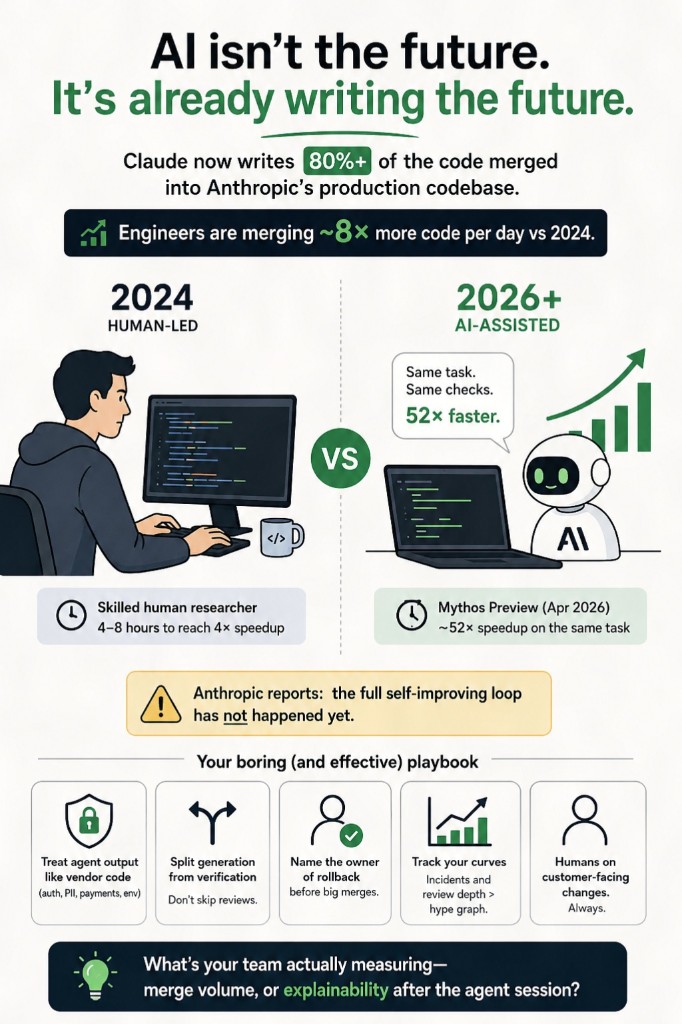
80% of production code. Written by AI. Reviewed by the same old habits.
Anthropic—the company behind Claude—just published internal numbers most labs keep private. The headline is recursive self-improvement. The footnote that should land on your desk: generation scaled. Verification did not.
In a June 2026 report titled When AI Builds Itself, Anthropic says its own codebase is now mostly written by Claude. Engineers merge roughly eight times as much code per day as they did in 2024. The company is not claiming science-fiction autonomy yet. It is warning that the curve bent faster than most institutions planned for—and asking the industry to build a credible pause button before the next bend.
The numbers Anthropic finally published
These are not marketing slides. They are operational metrics from the team building Claude:
- **80%+ of merged production code** at Anthropic was authored by Claude as of May 2026—up from low single digits before Claude Code launched in February 2025
- **8× daily merge volume** per engineer in Q2 2026 versus 2024, after two inflection points: models that run code (2025) and models that work autonomously over longer horizons (2026)
- **52× training-code speedups** in an internal benchmark by April 2026 (Mythos Preview), versus ~3× with Opus 4 in May 2025—a skilled human researcher needs four to eight hours to reach 4× on the same task
Read those together and the picture is not "Claude typed faster." It is Claude closing more of the loop between intent, experiment, and merge—with humans still setting goals and reviewing output, but a shrinking share of keystrokes.
What recursive self-improvement actually means
Recursive self-improvement is the scenario where an AI system designs and builds its own successor with little human input—each generation bootstrapping the next. Anthropic is explicit: that full loop has **not** happened.
What has happened is narrower and still consequential:
- AI writing most of the software at the company that ships Claude
- AI running experiment loops inside fixed goals—rewrite training code, benchmark, repeat—faster than skilled researchers on defined tasks
- Human roles shifting from typing to directing, reviewing, and choosing which problems are worth automating
That is not the singularity. It is a production line where the fastest tool on the bench is also the product—and the slope of improvement on internal tasks steepened inside twelve months.
Why Anthropic is asking for a coordinated pause
Jack Clark and Marina Favaro, writing for the Anthropic Institute, argue the world should have the **option** to slow or temporarily pause frontier AI development so alignment research and social institutions can catch up.
Their concern is compounding risk: if misalignment errors grow more frequent but less understood, teams lose the ability to diagnose failures before they scale. A pause only works if verifiable and global—otherwise the least cautious actor gains ground while others slow down.
Whether you find that alarmist or overdue, the policy ask matters for buyers: the maker of one of the most deployed coding assistants is publicly saying current velocity outruns governance design.
What this is not
Skeptics are right about one thing: more AI-written code at Anthropic mostly proves Claude is a strong engineering tool inside a lab with guardrails—not that machines are autonomously spawning successors overnight.
Do not confuse **acceleration on scoped tasks** with **unchecked recursive gain**. The report’s value is the trend line and the lab’s own admission that the trend line is steepening.
What web teams should do with this news
Most agencies and product teams are not training frontier models. You still inherit the second-order effects: faster codegen, longer autonomous sessions, and vendors shipping features tuned for speed narratives.
Practical responses look boring—and that is the point:
- **Treat agent output like vendor code:** review for auth, PII, payments, and env config even when generation feels effortless
- **Separate generation from verification**—the same split we wrote about when AI moved the bottleneck from writing to reviewing
- **Document who owns rollback** when an agent session merges across dozens of files
- **Ignore hype curves; track your curves:** incident rate, review time, and whether juniors can explain merged diffs without the chat log
If your team already feels the fun-and-friction mix of agent-assisted web work, that is the human-scale version of Anthropic’s graph. The difference is you feel production at 2 a.m.; they feel it at civilization scale.
The contrarian takeaway
Anthropic’s recursive self-improvement warning is not a trailer for a robot takeover. It is a status report from the frontier—and a mirror for web teams: merge volume can 8× while review depth stays flat.
Use the headline for strategy, not panic. Treat agent output like vendor code. Split generation from verification. Name who owns rollback. If you want a second opinion on where agent speed is helping—or outpacing—your review loop on a marketing site or product frontend, send a note.