
B2B marketing agency
Meridian Digital
B2B marketing site where paid traffic has to earn a conversation
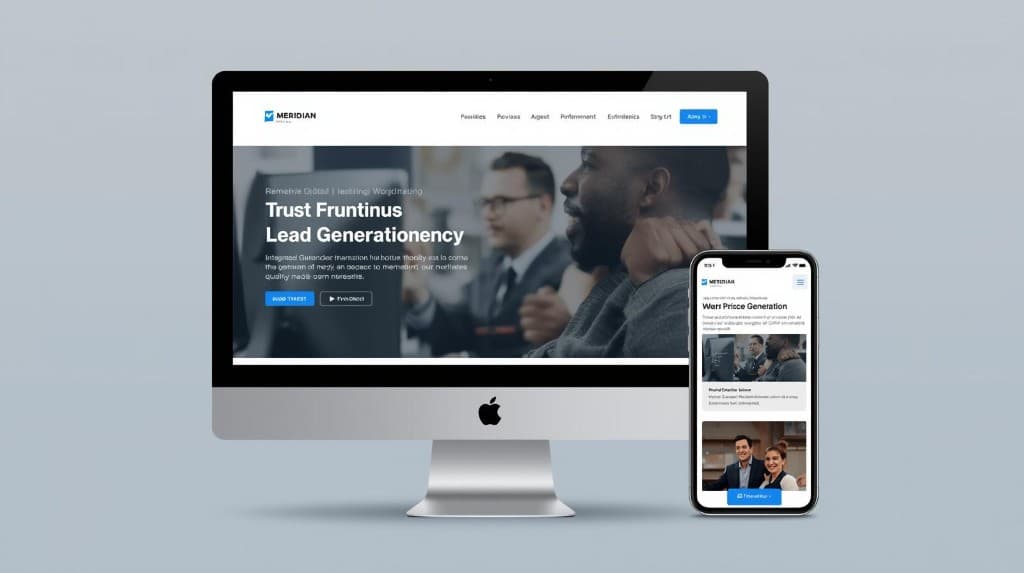
Meridian’s old site looked credible in a static PDF deck but broke down under campaign velocity: every launch needed a developer in the loop, and form data lived in inboxes instead of the CRM. The mandate was simple on paper—look enterprise, ship fast, measure what matters.
Context
The team sells complex B2B services with long sales cycles. Traffic arrives from LinkedIn and paid search; most visitors will not convert on first visit. The site’s real job is to qualify intent early—clear ICP fit, proof, and a low-friction path to a booked call—without burying leads in generic “contact us” noise.
Stakeholders were split between marketing (who needed weekly landings) and IT (who wanted fewer moving parts). Any solution had to respect brand guidelines that were already locked while still allowing modular layouts.
Constraints
No bespoke SPA for content editors: marketing had to publish without opening tickets for every headline swap. Performance targets were tied to paid media—slow LCP meant wasted spend, not just a Lighthouse badge.
Lead data had to land in the CRM with campaign attribution intact; exports from a dashboard were not acceptable as the system of record.
What we looked at first
We mapped the three dominant journeys: cold paid click → service page → form; organic → resource → nurture; and referral → case study → contact. Analytics showed the second path under-counted because event naming drifted between Tag Manager versions.
Competitive review focused on clarity, not decoration: who the offer is for, what proof exists, and what happens after submit. Several peers hid strong work below the fold on mobile—an easy win for Meridian if layouts stayed disciplined.
Approach
We separated “evergreen” templates (services, proof, team) from “campaign shells” designed to launch in hours: hero, story, offer, proof strip, single primary CTA. Editors assemble pages from blocks with guardrails—spacing, type scale, and CTA placement stay consistent so brand doesn’t drift with every experiment.
Forms post to endpoints the CRM team owns; server-side validation mirrors client rules so junk never pollutes downstream automation. Thank-you routes are real URLs, not modal dead-ends, which keeps measurement honest for assisted conversions.
Delivery notes
Core Web Vitals were treated as a feature: image discipline, font subsetting, and deferring non-critical scripts. We avoided third-party carousels and heavy builders that reintroduce layout thrash.
Editor training was one working session plus a short internal doc—because the system is boring on purpose. Boring systems get used.
Outcomes (directional)
Marketing could ship landings without engineering for routine launches; time-to-live for a new offer dropped from weeks to hours once templates existed.
Sales stopped re-keying leads; attribution fields were consistent enough for pipeline reporting without manual cleanup.
Stack & integrations
- WordPress (block theme)
- ACF / block library
- WP Rocket–class caching
- CRM webhooks
- GA4 + Consent Mode